

Seeing as how Trump and Putin are partners in crimes against humanity, I thought it would be apt to take a page from Russian history that historians have called “The Time of Troubles” to frame Trump’s impact on American society.
Reframing the history may even highlight the drivers of Trump’s accelerating descent into vindictiveness, criminality, corruption, defilement of human beings, and psychological disintegration. This isn’t just a mere history lesson, though.
In 1868 — more than 250 years after The Time of Troubles — the famous Russian composer Modest Mussorgsky put the history in an opera called Boris Godunov. The opera delves into the drivers of a despot’s mental decline better than a dry historical recounting of a nation’s rape, mismanagement, and subsequent trauma.
Mussorgy’s opera and the Time of Troubles Russia experienced provide a clarion call to today’s United States for the removal of the American regime and an overhaul of the system to more effectively protect itself and its citizens from criminality. If we as a nation do not heed the call, we may open ourselves to a Time of Troubles that rivals Godunov’s own reign.
I do have hope that America can again rise to the values espoused in its Constitution, just as it had for the fifty years before Trump’s first term in office. I believe after a generation or two that the United States can recover from the criminal element and demons that have subverted Democracy into an illiberal wonderland.
Time of Troubles
Between 1598 and 1613, Russia descended into chaos so complete that historians still call it the Time of Troubles. It began with a murdered child whose ghost would haunt an entire nation.
Boris Godunov had served as regent for the feeble Tsar Feodor. Godunov managed the empire’s affairs while the legitimate ruler existed in name only. He was also responsible for the well-being of the future Tsar, an eight year old boy named Dimitri.
However, Tsar Feodor died without an heir in 1598. The direct line simply ended, without an heir apparent. The death of the Tsar created a vacuum that Godunov swiftly filled.
The Parliament elected Godunov as Tsar, but everyone in Moscow knew the dark truth that no one dared speak aloud: Dmitri, the rightful heir, had died mysteriously seven years before while living under Godunov’s protection.
The official account claimed the eight-year-old boy fell on a knife during an epileptic seizure, but the wound — a clean cut across the throat — told a different story to anyone willing to see it.
Godunov ruled as Tsar for seven years, and every one of them was shadowed by that murdered child. His reign brought famine that starved millions, plague that killed thousands more, and an economic collapse that left the people desperate and angry.
When Godunov died in 1605, possibly by poison or perhaps simply crushed by the weight of his own guilt, Russia didn’t stabilize — it shattered. Multiple tsars claimed power simultaneously, Poland invaded and occupied Moscow, and the population declined by one-third as starvation and violence consumed the nation.
The nation had crowned a man they knew was guilty, and the Time of Troubles was the price they paid for that choice.
Also from The Pillaged American Century series …
The Weimar Warning: It Should Have Been Germany’s Century

Despite crushing reparations after World War I and triple-digit inflation, Germany concentrated within its borders the world’s leading scientists, researchers, designers, and craftspeople.
Mussorgsky’s Opera of Institutional Collapse
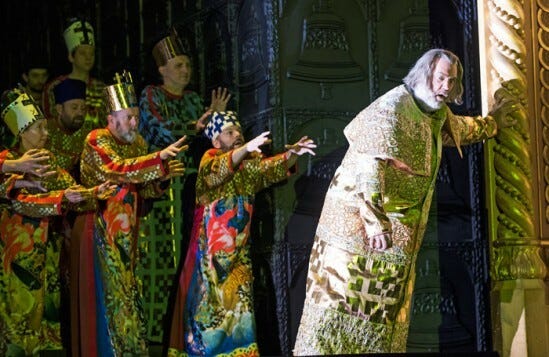
Mussorgsky’s opera Boris Godunov opens with the new Tsar’s coronation at the Kremlin. The people celebrate, the bells ring across Moscow, and Godunov stands before them trembling because he alone knows what he did to stand where he’s standing (watch the Youtube clip below of the haunted Godunov during coronation).
The opera follows his psychological disintegration across seven years of rule, watching as the guilt he cannot acknowledge slowly destroys his ability to govern and eventually his sanity itself.
In the first act, Godunov rules competently enough but cannot escape the murdered child even in sleep. By the second act, the hallucinations have intensified.
In the famous clock scene, Godunov converses with the dead boy’s ghost in front of his advisors, pawing at empty air and begging forgiveness from a phantom only he can see before collapsing in a raving fit.
Meanwhile, a young monk named Grigory has taken on the identity of the murdered Dmitri, claiming to be the child who miraculously survived Godunov’s assassination attempt.
He raises an army in Poland, and the Russian people, suffering under famine and plague while their Tsar talks to ghosts. Godunov’s enablers and handlers, the boyars, watch all of this unfold and begin quietly positioning themselves for whatever comes after Godunov.
The opera’s third act shows Russia fracturing as the pretender Dmitri advances on Moscow, the boyars scheme for personal gain, and the people starve while their Tsar proves unable to govern because he cannot face reality. The famine is real and requires action. But acting decisively would force him to confront the terrible actions he took to gain his crown.
In the fourth act, Godunov dies while raving mad, begging forgiveness. The pretender Dmitri marches unopposed into Moscow, and the opera ends not with resolution but with a Holy Fool — Simpleton or Yuródivyy in Russian — who bears witness to the drama unfolding, sings to the starving crowd: “Weep, weep, Russian people!”
The enemy comes, and darkness falls.
It is the Holy Fool in all his simple-mindedness who sees and understands what has happened in the past, comprehends what is happening now, and sees the more difficult times to come for the nation.
Mussorgsky’s genius was recognizing that illegitimate power corrupts not just the leader but every institution that touches it. Godunov’s crime was individual, but the Time of Troubles that followed was collective—a whole nation paying the price for crowning the guilty.
Beyond the Paywall we’ll explore Trump’s own ghost of his close association with Jeffrey Epstein, a pedophile and child sex trafficker (both girls and boys), and how Trump’s past is informing government policy.
